Sunday, August 17, 2014
summertime
This season, I keep thinking of that song summertime...and the livin' is easy. I'm not sure what the actual context of the song is, but I'm thinking it should be a farm. Because summertime on a farm--if you're not a farmer but a farmer's wife who loves to eat and cook--the livin' is easy. (I guess I should stress that part about not being a farmer but a farmer's wife...my farmer keeps dreaming of the easy living of winter, when the pantry's stocked with butternut squash and potatoes, and the chest freezer is full of pork, and the fields are sleeping.)*
However, I'm months into summer and still marveling about all the fresh food--and how easy it is to cook dinners that take zero effort and taste bright and rich. Like ratatouille! Not made the Pixar way, with Remy's mandolin-thin slices of veggies and showers of colorful herbs, but the peasant way (at least, I imagine), layered in a big dutch oven, covered with a lid, and simmered for forty minutes until stewy and soft. I made it last week, and between harvesting the eggplant, peppers, and tomatoes in the steamy tunnel, chopping all the vegetables, and picking some herbs, I was finished prepping (with the cutting board washed) in less than a half an hour...and reading my book on the couch while dinner bubbled away.
Summer produce is perfect for quick and forgiving meals like that, no recipe required, experimenting encouraged. But we've also delved into the deep waters of very unexperimental cooking this season: canning and pickling. And I just might have an addiction to it.
The whole process of canning is the opposite of my usual cooking style: you have to follow the recipe, no excuses; you can't make anything up; you have to measure precisely. Most unlike me, you have to lay everything out before starting and be organized. And prepared.
I find everything about it, from the timing to the boiling to the stirring to the gelling to the jar-filling to the dreaded water-bath processing, way too stressful. Most likely I'm just not used to it yet, but it seriously puts me in a sweat.
Somehow, though, every time I finish (read: collapse on the couch), I feel this giddy sense of satisfaction and self-sufficiency. The jars lined up on the counter are full of yummy preserves that will in turn fill our winter with the tastes of summer. The nectarine jam that might not have set will be delicious pancake syrup, and we will pretend that was the goal all along; the cardamom-plum jam will make winner PB&Js and probably even pair with caramelized onions to make chutney for pork-chops. The dilly beans and pickles will add crunch and tang to winter lunches.
And then I'm off dreaming about the next canning project, drama and stress forgotten. Today: turn four pounds of summer squash into hot cumin-spiced squash pickles (although whoever heard of a squash pickle?!). Next weekend: melt tomatillos into enchilada sauce. And the pinnacle: transform tomatoes into canned chopped tomatoes, tomato sauce, and tomato-basil jam.
Still, post-canning session, I always need a simple meal like ratatouille to restore my kitchen confidence.
Simple summer ratatouille
You can fool with ratatouille as much or as little as you want. The traditional French method, apparently, is to first brown each of the vegetables separately, then stew them together. Possibly I shouldn't mess with French tradition--they know a thing or two about food more than I do. But I find my cheater method irresistible. If you add the 1/3 cup water, you'll have a rich and filling vegetable broth to heat up the next day for a simple lunch best soaked up with a slice of bread. (Use a slotted spoon to dish up the ratatouille if you do this.) Whatever you do, be free, toss around your herbs like Remy, and hum along to some French music while you chop vegetables. Now one of our end-of-summer goals is to make ratatouille at least once a week while the veggies last.
1 tablespoon butter
1 large onion, diced
2 green peppers, stem and seeds removed, sliced thinly lengthwise
2 medium summer squash, cut into 1/2-inch rounds
2 medium eggplants, cut into 1/2-inch rounds
3 large heirloom tomatoes, roughly chopped
1/3 cup water (optional)
1 teaspoon minced fresh rosemary
1 teaspoon minced fresh oregano
2 tablespoons minced fresh basil, separated
Salt and pepper to taste
Heat the butter in a 6- to 8-quart cast-iron pot (or heavy-bottomed saucepan) over medium heat. When it's melted and hot, add the onions and cook for about 5 minutes, until the onions are glossy and soft--don't stir too much, as a little browning on the bottom of the pan is good for flavor.
Next, scatter the green peppers in a layer on top of the onions. Summer squash comes next in another rough layer, followed by the eggplant and then tomatoes. Pour in the 1/3 cup water. Sprinkle the rosemary, oregano, and half of the basil on top (or, if you're feeling like a particularly creative French rat/chef, you can get fancy with these spices and throw them around a little!); season with salt and pepper to taste; and cover.
Let stew for approximately 40 to 50 minutes, stirring only very occasionally (this is excellent book-reading time). The ratatouille is done when the veggies are soft, but still hold their shape.
Top with the remaining basil. Pair with pearl barley for a heartier meal, or with big hunks of rustic bread and butter for something simpler.
Notes: Like I said above, you can make this as simply or extravagantly as you'd like, and this doesn't just refer to cooking method. Focus on one herb instead of three if you'd rather; add some sherry or white wine if you want (although the flavor really doesn't need the boost); mince some garlic to add with the onions.
*I'll extra stress that point, since my farmer's response to reading the first sentence of this post was "the livin' is easy?!" But he did laugh about the pork part, because it is very true.
Thursday, July 3, 2014
chicken coop
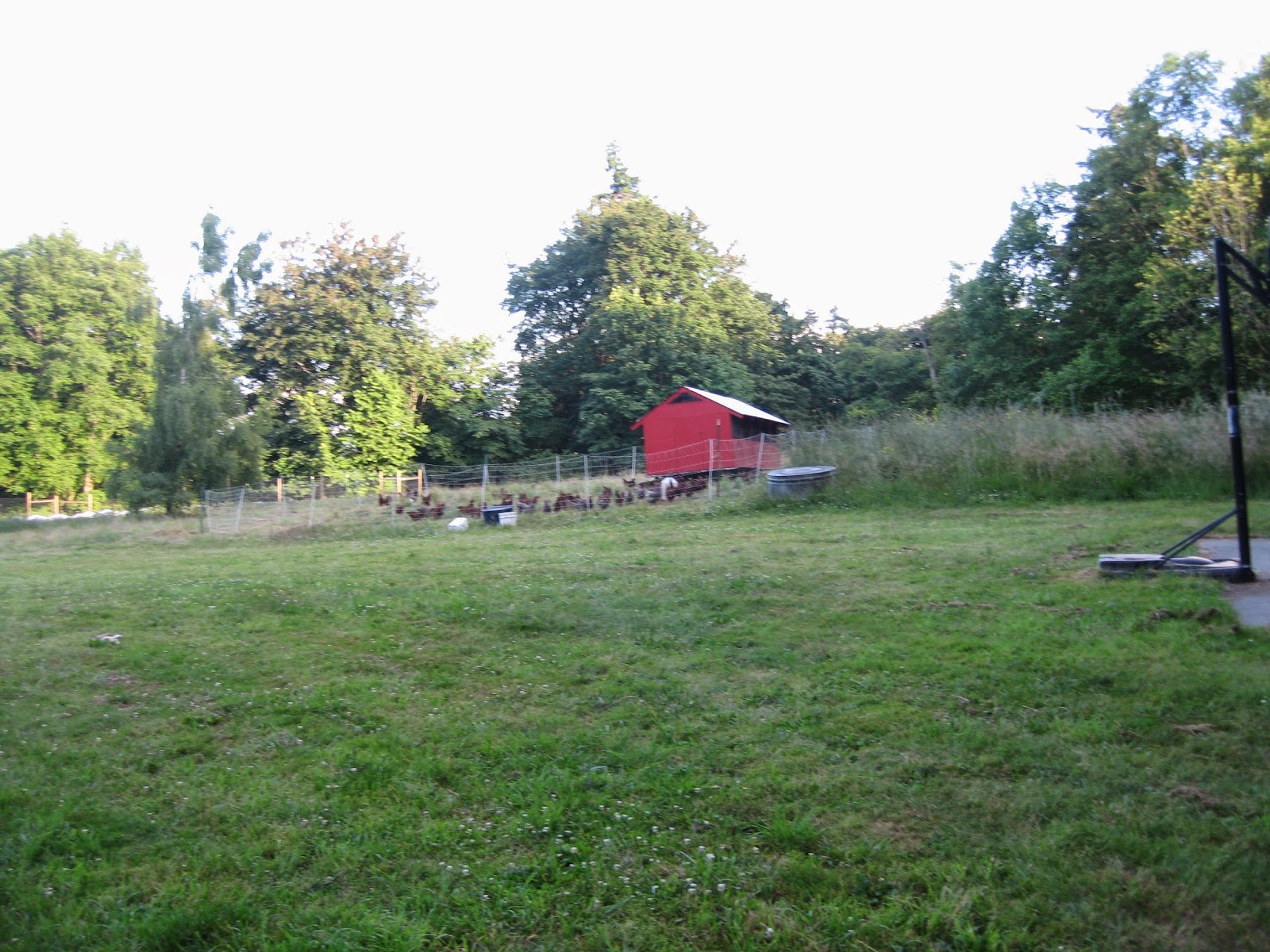
One excessively rainy Saturday early this spring, Tim and I set off in muck boots and rain gear to move the chickens. The chickens cycle through the fields throughout the year, moving every few weeks to new pecking ground. Early this spring, the farm had two separate flocks. The youngest flock, about seventy chickens, lived in the Ski Coop, so called because it's mounted on skis for easy (ish) dragging around. The older flock, about twenty or so chickens, lived in the rustic gem to the left. It's been used on the farm for about a decade.
And, in this excessive downpour, I discovered that to move this coop, you have to take it all apart. Lift off the roof, cut the twine that ties the four sides together, move all the parts, and then tie them back together. Then move the racoon-proofing chicken wire and bricks. I was rather surprised that the farm has been doing this every few weeks for the last ten years--and quickly became even more excited that Tim has built a new one.
Meet the mobile coop!
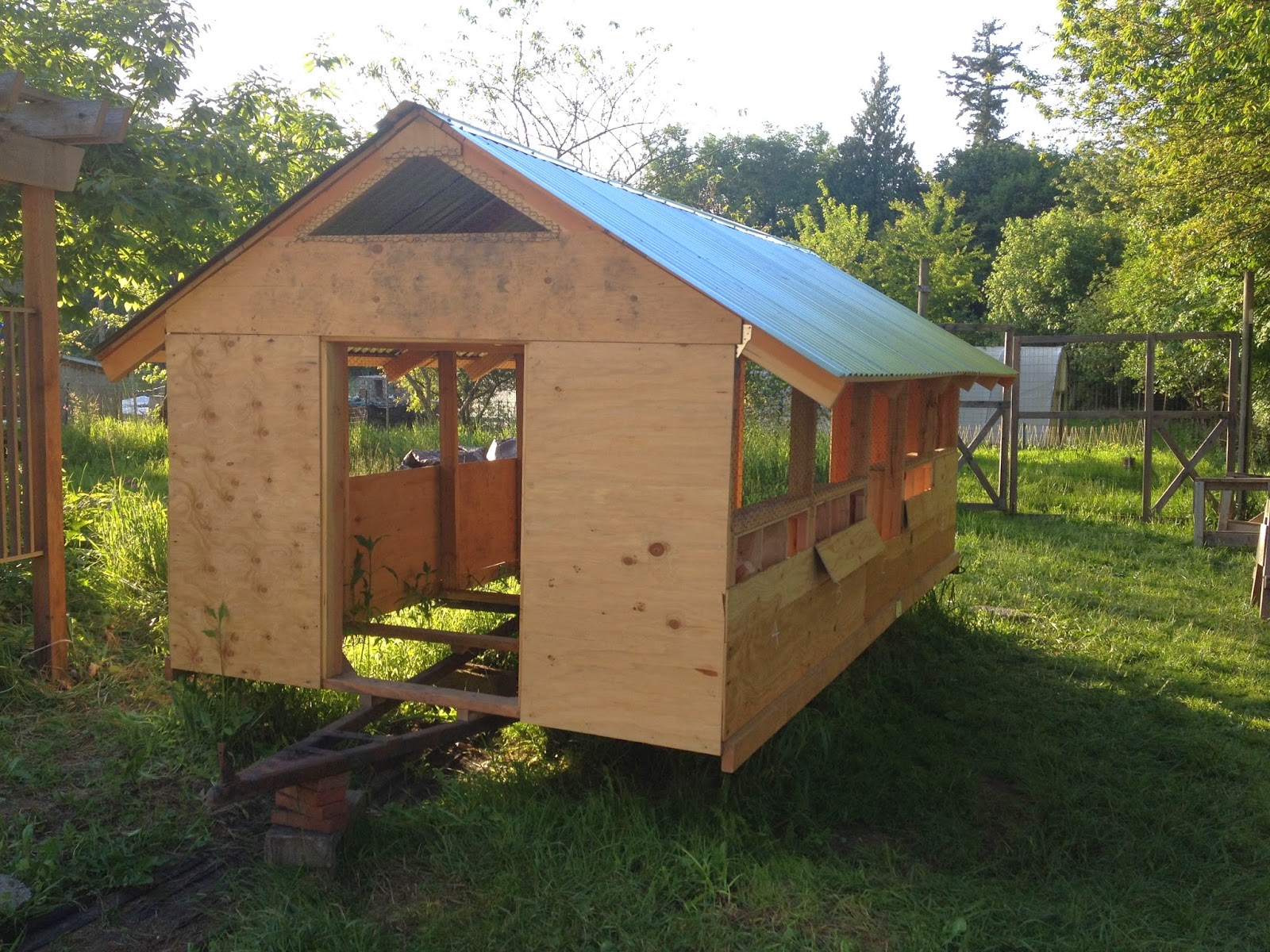
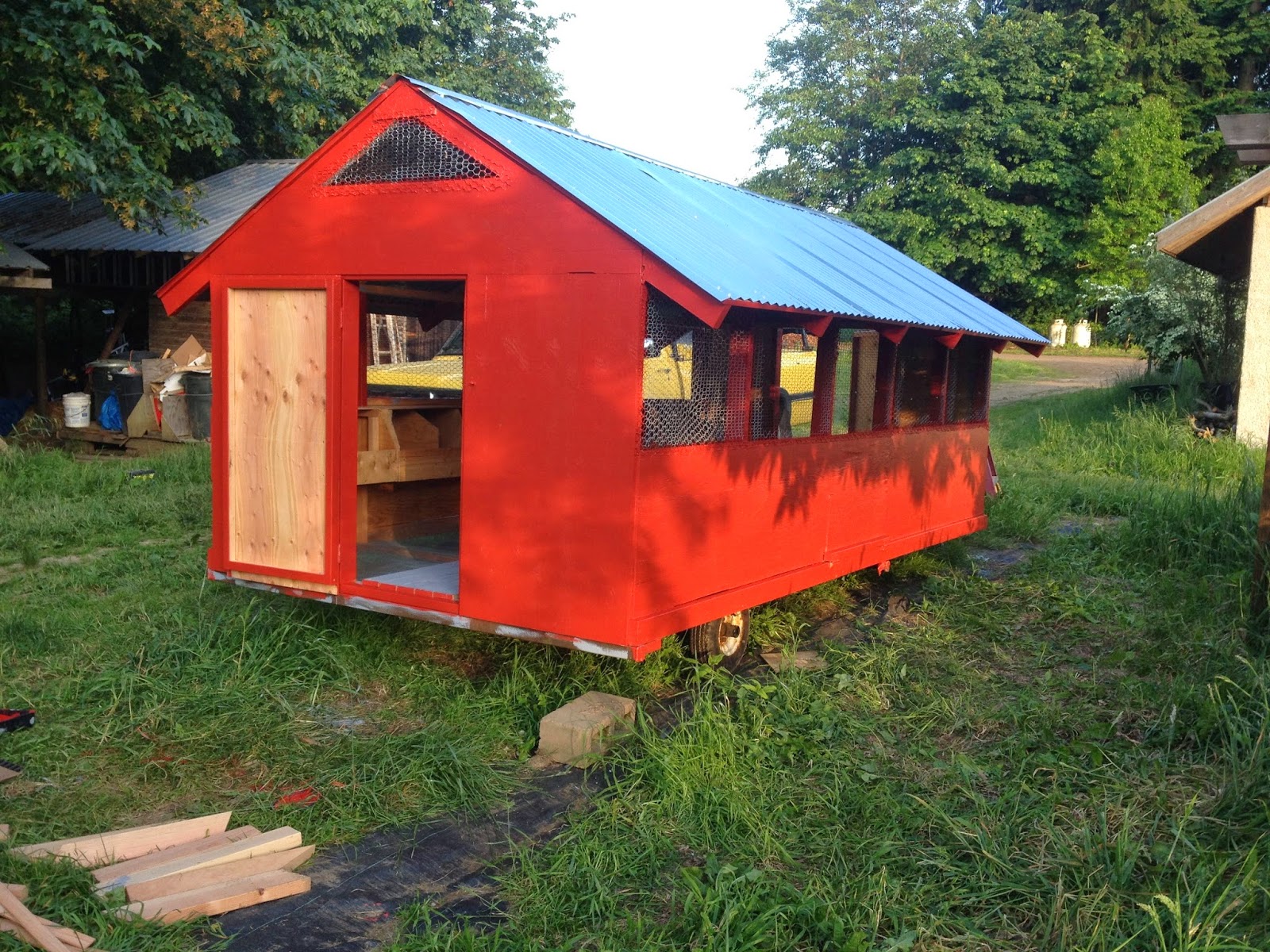
Tim was the master planner and builder behind it all and, because side projects like this always take second place to actual farming, it became our weekend pet. The coop is framed on top of an old boat trailer, so the tractor can haul it from field to field. Nesting boxes run all along one side, with little doors for easy egg access; there is enough roosting space for 120 hens, a narrow pathway down the middle for walking inside, and plenty of ventilation.
My excitement is not purely selfish happiness that I never have to take apart that dreadful collapsable coop again (although that is some of it). No, most of my excitement has been watching it take shape from stacks of plywood and graph paper sketches and long, imaginative brainstorming sessions—through lengthening spring evenings of working with Tim after work to pound nails, measure chicken wire, draw up plans for nesting boxes, and battle with chicken staples—to grow into a coop. I'm honestly a little sad that it's finished, the building was so delightful.
But the chickens aren't sad: Now, about one month after its launch into the fields, the flock's egg production has reached record highs—an average of 65 eggs per day! The spike is partly due to summer, but also because the nesting space has gone from two nesting boxes to thirteen. And the farmstand still sells out!
And, in this excessive downpour, I discovered that to move this coop, you have to take it all apart. Lift off the roof, cut the twine that ties the four sides together, move all the parts, and then tie them back together. Then move the racoon-proofing chicken wire and bricks. I was rather surprised that the farm has been doing this every few weeks for the last ten years--and quickly became even more excited that Tim has built a new one.
![]() |
| The framework takes shape on top of the boat trailer |
![]() |
| The master builder, Tim! |
![]() |
| With siding, the coop looks like a little house! We were tempted to hook it up to Bertha and take off... |
![]() |
| Tin roofing goes up |
![]() |
| Most of the flooring is hardware cloth; this walkway is for ease of cleaning and inside access. |
![]() |
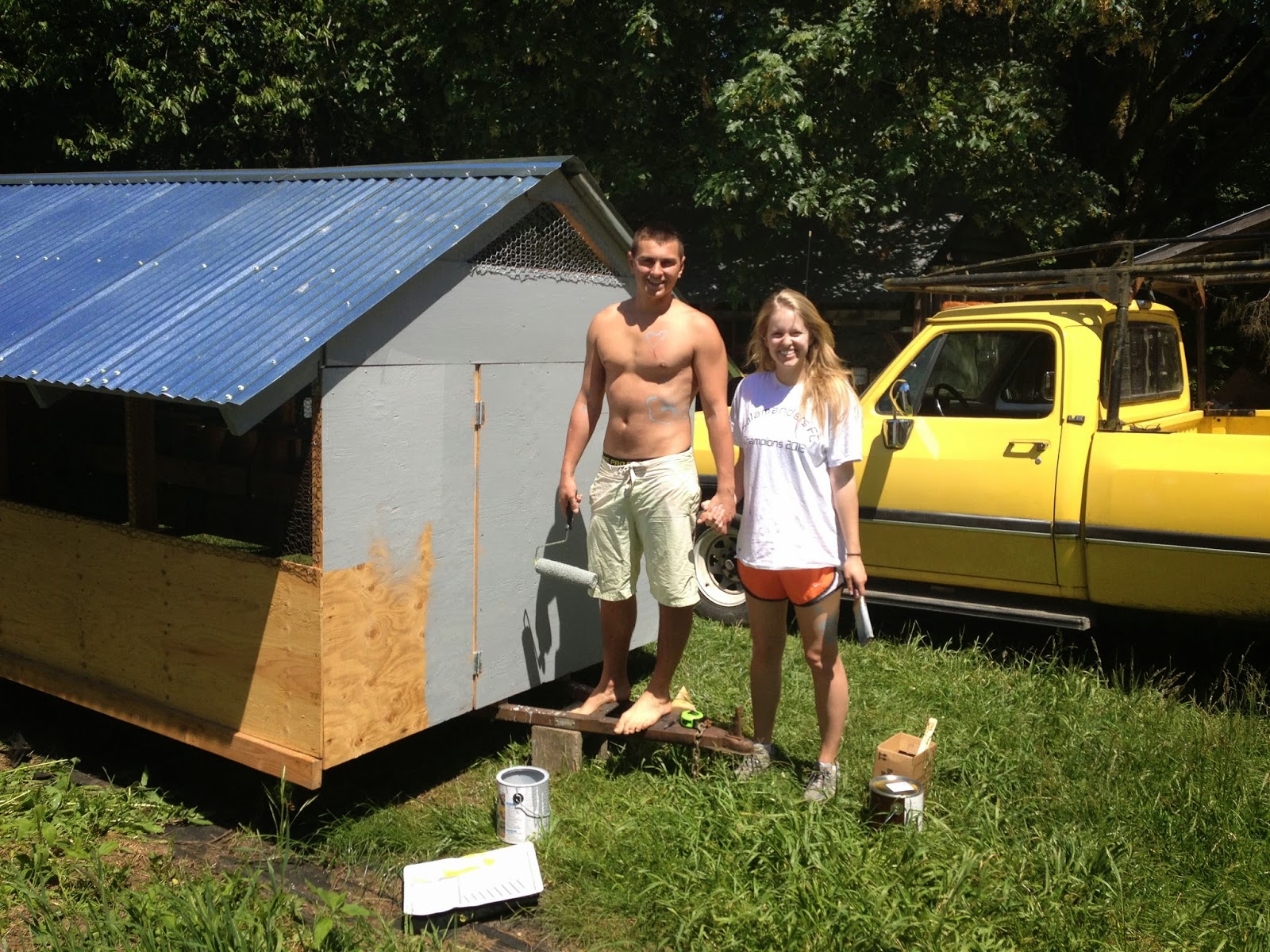
| Matt and Steph, our star painters! |
![]() |
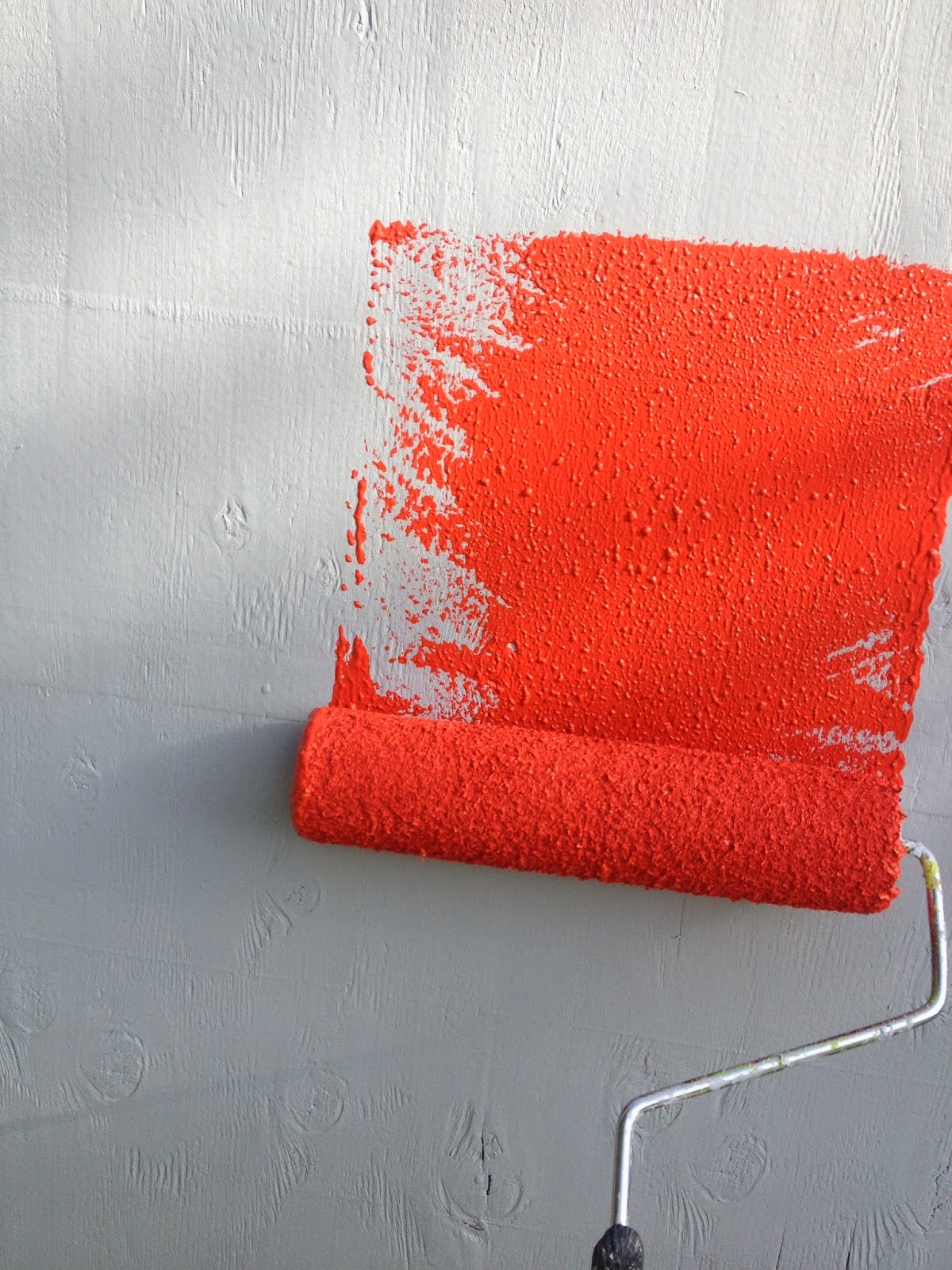
| I said "it must be red!" |
![]() |
| The final painted coop |
But the chickens aren't sad: Now, about one month after its launch into the fields, the flock's egg production has reached record highs—an average of 65 eggs per day! The spike is partly due to summer, but also because the nesting space has gone from two nesting boxes to thirteen. And the farmstand still sells out!
Wednesday, July 2, 2014
bounty
For most of the spring, we ate lettuce. I love farm lettuce—devoured right there in the field, crispy and sweet off the stock; or drizzled with a little olive oil and balsamic; or wilted with pasta. But we ate a lot of lettuce.
Now that it's July, though, the farm is starting to kind of explode with a bounty that makes me feel a little frantic. Pick! Eat! Pickle! Experiment! The bounty also makes me feel deliciously happy and summery--the first night we strolled the farm in this new season of plenty (more than a few weeks ago now), I almost cried. We stumbled back to the farmhouse trying to juggle fennel, broccoli, turnips, peas, beets, and more lettuce, hungry for our veggie feast even after our cherry, raspberry, and blueberry appetizers out in the fields. We've roasted, sautéed, and pickled the beets and radishes; diced the fennel in salads; roasted the broccoli with just a sprinkle of salt and pepper; folded roast turnips into enchiladas; and crunched peas plain.
Our herb garden keeps on chugging along too; last weekend, I spiced some canned tomato sauce with fresh-chopped rosemary and oregano for a pizza that (topped with fresh chèvre that our new goat-dairy-owning friends gave Tim after he spent a day working with them) was fairly revolutionary.
The bounty is ever-changing, and we're already saying goodbye to peas (although I really feel like I was just getting to know them, to enjoy the juicy bursts of shell peas in pasta, to savor the crunch of snap peas sautéed in butter and mint) and hello to summer squash. We celebrated the first zucchini last weekend shaved and smeared with an easy almond-parmesan pesto, and the first yellow summer squash today sliced thin and dressed up with chopped basil and mint.
One of the interns just put up a CARROTS sign out on the road and I hear rumors that the first tomatoes will blaze onto the dinner (and lunch and breakfast) scene in two weeks.
I think the richness of this season is compounded by the waiting of spring--the rain, the watching of things growing, the eating of kale and lettuce, the dreaming of summer. Remind me of this next winter!
Thursday, May 29, 2014
simple soup
We love to make soup. Most of the year, no other meal could be more satisfying—it's hot and hearty, simple, always adaptable. Our staple soup this spring has been lentil, which I love because it requires no grocery store trip or special planning: lentils, potatoes, onions, and cumin are always stocked in our cupboards and the farm always has some kind of greens to harvest and toss in at the last minute.
This week, we wanted inspiration for a new mix of flavors, which meant we reached for Best Recipe's Soups, Stews, and Chilis. An Asian soup sounded intriguing, and we picked the first one we saw—Japanese soba noodle soup—because it called for spinach and the farm has tons.
A caveat first: we did not really follow the ingredients list. However, this not one of those recipe reviews that reads like, "Zero stars! I substituted dill for the cilantro and lemon for the lime, and it didn't taste Mexican at all!" No--all we did was simplify. (I love Best Recipe's philosophy to print only the best recipes, but sometimes I do not want the best; I want the easiest.)
The original recipe calls for shiitake mushrooms, which you use to make your own mushroom broth. We didn't want to spend $12 per pound on mushrooms and our pantry is bursting with chicken stock, so we ditched the shiitake for white mushrooms (so much more attractive at $3 per pound) and used chicken broth. We made a few other minor adjustments (no mirin, which the recipe called for), and ended up with a rich, flavorful, and simple soup. Springlike, said Tim, because it's light and brothy. Fall-like, I said, because the mushrooms add a deep earthiness. Take your pick—either way, it's a repeat dish.
Japanese Soba Noodle Soup
{This recipe made 2 meals for us}
8 cups chicken broth
4 tablespoons soy sauce
8 scallions, dark green parts and light green parts separated and roughly chopped
9 ounces soba noodles
8 ounces white mushrooms, roughly sliced
Spinach, washed and roughly chopped (we probably used 6+ ounces; the recipe calls for 3 ounces)
1 tablespoon toasted sesame seeds (optional; I accidentally blackened ours until they shone like tiny grains of obsidian, so we did not have any!)
Combine the broth, soy sauce, and dark green, roughly chopped scallions in a stockpot over medium heat.
While the broth is warming up, fill another pot with 4 quarts of water and bring to a boil over high heat. Once the water is boiling, pour in the soba noodles and cook, stirring frequently, for 4 minutes. Test a noodle--it should be tender, but definitely not mushy. Drain, rinse with warm water (Best Recipe stresses this: warm, not hot or cold), and set aside.
Now the broth should be simmering. Add the sliced mushrooms and simmer until tender. Then stir in the spinach and let it wilt, but only just.
Portion the noodles into individual bowls, then ladle the soup over the top. Sprinkle with the rest of the scallions and the sesame seeds (if they survived your toasting), and enjoy.
Note: If you have leftovers, the noodles will be much mushier the next day unless you keep them separate in the fridge. We didn't bother to keep them separate and it was fine, although not the delicious al dente of the first day.
Now the broth should be simmering. Add the sliced mushrooms and simmer until tender. Then stir in the spinach and let it wilt, but only just.
Portion the noodles into individual bowls, then ladle the soup over the top. Sprinkle with the rest of the scallions and the sesame seeds (if they survived your toasting), and enjoy.
Note: If you have leftovers, the noodles will be much mushier the next day unless you keep them separate in the fridge. We didn't bother to keep them separate and it was fine, although not the delicious al dente of the first day.
Thursday, May 22, 2014
cooking
I am completely obsessed with cooking. It's partly Smitten Kitchen (we joke that Deb rules our kitchen—what she writes, we cook), partly farm bounty, partly just plain excitement experimenting with food.
Plus I'm reading all these food books—recently, The Butcher and the Vegeterian and Ratio. Ratio is particularly hunger-inducing and I find I can only read it in small bits, tackling the pie dough chapter one week, the custard chapter the next.
On top of it all, I bike a lot, and often my rides turn into extended cooking daydreams...my wheels spin the miles away and my mind spins plans to make a ginger–soy sauce glaze for salmon or toast a new combination of nuts, seeds, and oats into crunchy granola.
My most elaborate bike-fueled meal plan became Mother's Day brunch. I cooked nearly nonstop that weekend, on Saturday a graham cracker crust and pastry cream and sliced strawberries to stash in the fridge for Sunday dessert, then homemade pizza all evening, a feast of herbed dough and fresh mozzarella. Sunday started with brunch prep before church, then a whole afternoon playing head chef and ordering around my soux-chef husband, dad, and sister as we baked, cooked, sautéed, chopped, and plated a spring feast. It was every bit as luscious as I'd dreamed while cycling to the water taxi.
And then—and then. I promised myself I would take Monday night off. But when I got home, I discovered a lonely hunk of the last week's no-knead bread on the counter, so dry I couldn't even hack at it with our new bread knife, and just had to rescue it. A la Ratio, a ridiculously simple custard base and some cinnamon and about 5 minutes of work became bread pudding.
Tuesday, I promised myself another night off. But then there were turnips—perfectly round and golf-ball-like turnips out in the hoop house, basically bursting out of the soil and begging to be sautéed in butter and sherry (doesn't everything?) with some chive blossoms sprinkled on top.
Finally, tonight—after another week of cooking frenzy, my biggest triumph fish tacos on the fly—I have been stopped in my tracks. We bought a whole chicken this weekend, so on the water taxi this afternoon I let hints of this article (http://www.nytimes.com/recipes/1016335/steak-mock-frites.html) inspire my dinner plans. Chicken, rosemary from right outside our door, butter, and mock fries. Seriously, what could be better?
To be completely honest, when Tim replied to my butter! chicken! rosemary! text with I already have dinner cooking!, my first instinct was to call him and cry, "halt!"
I am that addicted.
And Tim knows it. His first reply was Sorry!!!
But I am a smart wife. I might even go so far to say that it's a dreamy thing to have a husband who cooks too, who I have to race to the kitchen, who concocts feasts like lentil stews and chilis—without even consulting a recipe book or website—that are most often better than my attempts at the same things with recipes.
For now, my mock-frites vision must wait. I must relax on the couch to the smell of slow-cooking chicken and piles of melting vegetables seeping out of our slow cooker and...dream up tomorrow night's dinner.
Thursday, May 15, 2014
the cilantro miracle
In March, on one of our first weekends at the farm, we cleared out a narrow bed along the fence right outside our house and planted the herb centerpieces from the rehearsal dinner. We also raided the farm's seed stores for past-date things and scatter-sowed the rest of the bed with huge handfuls of chard, mustard green, cilantro, and dill seeds. But watering and waiting brought only green weed sprouts, and after a few weeks of checking the bed we gave up. Too early, we said, and too cold for anything to make it; it wasn't even spring! And then my hoped-for house plants died. Isn't it sad, I thought, that I live on a farm and can't grow a thing?
But this morning, as we were stretching post-run out in the grass, Tim said, "Hey look, chard!" I lunged my way slowly over to the bed—which I thought had been lost to weeds. But there was chard, about two inches tall. Tim pointed again. "And mustard!"
Now the hunt was on. And in seconds I discovered—it couldn't be—something vibrantly green with lacy-edged leaves; so small still, barely three inches tall, that I almost couldn't relate it to its gangly grocery store sibling. This was cause for shrieking, even at 7 in the morning.
"Tim! Cilantro!" I yelped. We smashed a leaf between our fingers and sniffed (actually I did; Tim just popped one in his mouth). And voila, magic, surprise, it was cilantro, and now we could see it everywhere, up and down the bed, so much that I kind of felt stressed out. "Enchiladas! Tonight!" I cried.
Now we were down on our knees in the wet grass, searching the bed for more. This spiky gray-green thing? That fuzzy purple-green thing? Tim pronounced them weeds.
"What about this?" I pinched off a handful of something else green and feathery.
Tim sniffed. "Dill!"
I sniffed too. And yes, dill it was, smell-able even through the rich cilantro scent still sticking to my fingers, making an herby cocktail that nearly knocked me over.
I'm pretty sure we planted other things, although now I can't remember what they were, that didn't come up. But long after we gave up hope—and completely forgot about it all—those hardy past-date seeds decided to sprout en mass! And yes, we are most definitely having enchiladas tonight with cilantro on top.
Tuesday, May 6, 2014
fava beans
This year, I discovered that their flowers smell sweet and sugary, like a light perfume. Their smell filled the tunnel the other night as I harvested radishes and turnips.
Subscribe to:
Posts (Atom)